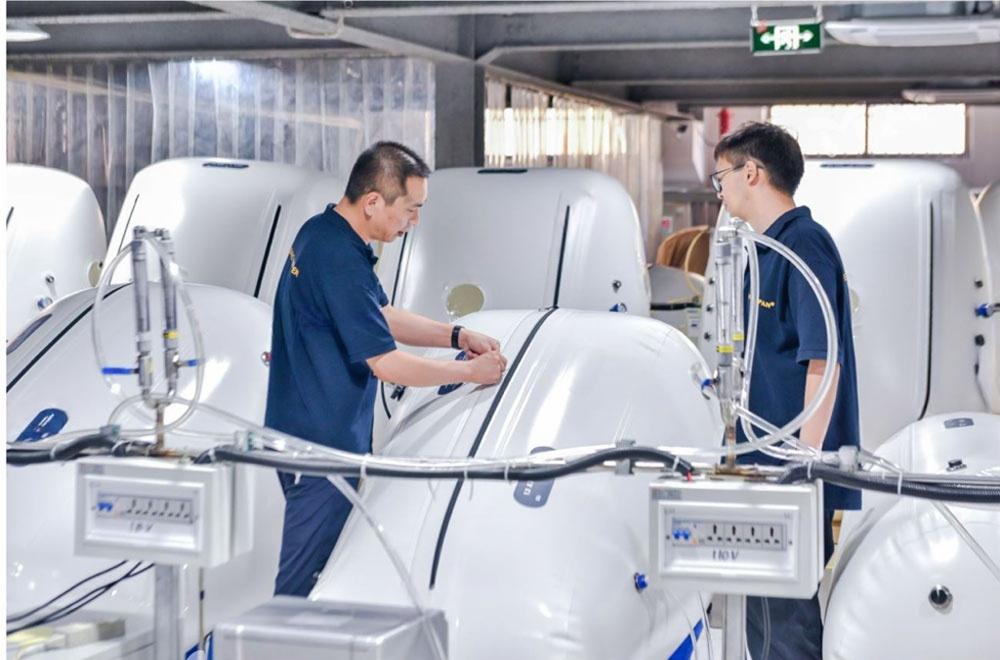

That low price tag on an overseas hyperbaric chamber is tempting. But what happens when hidden fees and shipping problems destroy your budget and your business plan?
The most significant hidden costs when importing a hyperbaric chamber aren't small fees but major, predictable risks. These include choosing the wrong chamber for your business, misunderstanding shipping terms like FOB, overlooking after-sales support, and lacking the correct market-specific certifications, which can result in a total loss.

I've seen it happen many times. A buyer, maybe an entrepreneur like you or a purchasing manager like our client Alan in the US, finds what looks like a fantastic deal. They focus only on that initial factory price. But that number is just the beginning of the story. The real cost of the chamber, the Total Cost of Ownership, is what truly matters for your investment. Let's break down where the real costs are hiding so you can make a smart, profitable decision.
How Can Shipping Terms Hide Massive Costs?
You see a very low "FOB" price and think you've found a bargain. But this price hides a world of logistical headaches and extra costs that are now your responsibility.
FOB (Free on Board) means the supplier’s job ends once the chamber is on the ship.1 You must pay for everything else: ocean freight, insurance, port fees, customs, and final delivery. A DDP (Delivered Duty Paid) quote, while higher, includes all these, giving you a clearer final cost.

A frequent question we get from first-time importers is, "Which shipping term is best?" There's no single answer, but understanding the risk you're taking on is crucial. With an FOB price, the initial number looks great on a spreadsheet, but you are now managing an international logistics project. You have to find a freight forwarder, negotiate rates, handle insurance, and pray there are no delays at customs. An experienced buyer like Alan knows to ask for multiple quotes. He'll ask for an FOB price, but he'll also ask for a CIF (Cost, Insurance, and Freight) or even a DDP price to his door. This allows him to compare the total landed cost, not just the factory price.2 What we advise our clients is to understand what each term means for their bottom line.
Shipping Term Responsibilities
| Incoterm | Supplier Responsibility | Buyer Responsibility | Risk Level for Buyer |
|---|---|---|---|
| FOB | Get goods to the departure port and onto the vessel. | All ocean freight, insurance, import customs, and final delivery. | High |
| CIF | All FOB tasks + pay for ocean freight and minimum insurance.3 | Import customs, port fees at destination, and final delivery. | Medium |
| DDP | All costs and risks to deliver the goods to the buyer's door.4 | Unloading the goods. | Low |
By comparing these options, you can see if the supplier's DDP price is fair or if you can manage the logistics more cheaply yourself. But remember, managing it yourself has a cost in time and risk.
Is Your Chamber a Money-Maker or a Costly Paperweight?
You need a chamber for your busy wellness center, and a home-use model is half the price. It seems like a smart way to save money upfront. But can it really handle the workload?
The biggest hidden cost is often buying the wrong tool for the job. A home-use chamber in a commercial setting leads to frequent downtime, expensive repairs, and a damaged reputation.5 The initial savings are quickly erased by the cost of a non-functioning business asset.

Here’s a scenario we've seen happen with buyers who focus only on the initial price: They buy a chamber designed for one or two sessions a day and try to run it for eight hours straight in a clinical setting. It’s like using a family car to run a full-time taxi service. It might work for a short while, but it wasn't built for that constant wear and tear. Components will fail sooner, the chamber will spend more time being repaired than making you money, and clients will go elsewhere. The cost of that downtime and reputational damage far exceeds any savings on the initial purchase. A professional chamber is built with more durable materials and components designed for a high duty cycle. It's an investment in reliability.
Commercial vs. Home Use Breakdown
| Feature | Home-Use Chamber | Professional Chamber | Why It Matters for Cost |
|---|---|---|---|
| Pressure Rating | Typically 1.3-1.4 ATA | Typically 1.5-2.0 ATA | Higher pressure models require stronger, more expensive materials. |
| Duty Cycle | 1-2 sessions/day | 8-12+ sessions/day | Built for continuous operation without overheating or premature wear.6 |
| Component Quality | Consumer-grade zippers, valves | Medical/Industrial-grade parts | Reduces failure points, downtime, and repair costs. |
| Lifespan | 3-5 years | 8-10+ years | Lower long-term cost per session and higher resale value. |
Before you buy, you must be honest about your business case. How many sessions will you run per day? Answering that question honestly will guide you to the right chamber and save you from the massive hidden cost of buying the wrong asset.
Does a "Good" Warranty Actually Cost You More?
Every supplier promises a great warranty, maybe one, two, or even five years. But when a critical part fails, you find yourself stuck in a timezone-lagged email loop, losing revenue every single day.
A warranty is only as good as the supplier's ability to support it. The real hidden cost is business downtime.7 You must ask about their process for international parts replacement, their stock of spare parts, and their live technical support. A clear, fast process is more valuable than a long warranty period.

I once worked with a clinic owner in South Africa who bought a chamber from another supplier with a "5-year warranty." When a pressure valve failed, he learned the warranty required him to ship the 300kg chamber back to the factory. It was completely impractical. His business was down for six weeks while he sourced and paid for a new part himself. This is why when we talk about Total Cost of Ownership, support is a huge factor. The initial price and warranty period are less important than the supplier's support system. What we advise our clients is to ask very specific questions about the after-sales process. A good supplier has thought about this and has a clear plan.
Here are the questions you should ask every potential supplier:
- What is your exact process for a warranty claim from my country?
- How quickly can you diagnose a problem remotely? Do you offer video support?
- Where do you stock spare parts, and what is the typical shipping time to my location?
- Who pays for the shipping of warranty parts?
- Do you provide detailed service manuals and training videos so my staff can handle minor repairs?
A supplier who can answer these questions confidently is one who has invested in a support structure, which is a far better guarantee than a simple number on a warranty certificate.
Why is a Missing Certificate the Most Expensive Mistake?
You’ve done your research, paid for the chamber, and it has shipped. But then you get a call from customs. Your entire shipment is blocked because it’s missing a specific certification document.
Certification isn't an optional extra; it is your legal license to import and operate the chamber.8 Without the correct certification for your market (e.g., FDA for the USA, CE MDR for Europe), your chamber can be seized by customs9, resulting in a total loss of your entire investment.
This isn't a hidden fee; this is a catastrophic failure. The responsibility for compliance almost always falls on the importer—that's you.10 When a client in North America or Europe asks about certification, we guide them to verify everything. We know that a chamber without the proper CE marking under the Medical Device Regulation (MDR) can't legally be placed on the market in the EU.11 Similarly, in the USA, the FDA has specific classifications and requirements.12 A supplier simply saying their product is "CE certified" isn't enough. You need to ask for the documents, check the issuing body, and ensure it applies to the specific product you're buying. It's also critical for your business insurance. No insurance company will cover a business using an uncertified medical-grade device. You would be taking on all the liability yourself. This is the one "hidden cost" that can cost you 100% of your investment and leave you with nothing.
Conclusion
Importing a hyperbaric chamber involves more than the sticker price. By planning for logistics, operational use, support, and compliance, you can turn a major purchase into a secure investment.
"Know Your Incoterms - International Trade Administration", https://www.trade.gov/know-your-incoterms. The International Chamber of Commerce’s Incoterms 2020 rules define Free on Board as delivery when the goods are placed on board the vessel at the named port of shipment, after which risk generally transfers to the buyer. Evidence role: definition; source type: institution. Supports: FOB means delivery occurs when the seller places the goods on board the vessel at the named port of shipment, with risk generally passing to the buyer at that point.. ↩
"Duty - Cost Insurance and Freight (CIF) - help.CBP.gov", https://www.help.cbp.gov/s/article/Article1126. Trade-agency guidance defines landed cost as the full cost of imported goods after adding transportation, insurance, duties, taxes, customs charges, and related destination expenses to the purchase price. Evidence role: definition; source type: government. Supports: Landed cost includes the purchase price plus freight, insurance, duties, taxes, customs fees, and other costs needed to bring imported goods to the buyer.. ↩
"Cost-Ins.-Freight (CIF) | BETA - International Trade Administration", https://beta.trade.gov/article?id=Cost-Insurance-and-Freight-CIF. Incoterms 2020 describes Cost, Insurance and Freight as requiring the seller to arrange carriage and provide minimum insurance cover to the named port of destination, while other import-side obligations may remain with the buyer. Evidence role: definition; source type: institution. Supports: CIF requires the seller to contract and pay for carriage and minimum insurance to the named port of destination.. Scope note: The exact cost allocation can vary if the sales contract modifies the standard Incoterms rule. ↩
"Know Your Incoterms: An Overview - The Market Diversification Tool", https://beta.trade.gov/article?id=Incoterms-Overview. Incoterms 2020 defines Delivered Duty Paid as the rule under which the seller bears the costs and risks of delivering goods to the named destination, including import clearance and duties unless otherwise agreed. Evidence role: definition; source type: institution. Supports: DDP requires the seller to deliver the goods to the named destination and bear most costs and risks, including import clearance and duties where applicable.. Scope note: The article’s phrase “buyer’s door” is accurate only when the named DDP destination is the buyer’s premises. ↩
"Design Considerations for Devices Intended for Home Use - FDA", https://www.fda.gov/regulatory-information/search-fda-guidance-documents/design-considerations-devices-intended-home-use. FDA guidance on home-use medical devices emphasizes that device design, labeling, and risk controls are tied to the intended users and use environment, which contextually supports the risk of deploying home-use equipment in a commercial workload. Evidence role: general_support; source type: government. Supports: Medical devices are designed, labeled, and risk-assessed for specified use environments, and using them outside those conditions can create maintenance and safety risks.. Scope note: This supports the mechanism and regulatory context but does not directly quantify downtime or reputational damage for hyperbaric chambers. ↩
"Duty cycle - Wikipedia", https://en.wikipedia.org/wiki/Duty_cycle. Engineering references define duty cycle as the fraction of a cycle or period during which a device is operated, a rating used to keep equipment within thermal and mechanical design limits during repeated or continuous use. Evidence role: mechanism; source type: education. Supports: Duty cycle describes the proportion of time equipment can operate within a specified period without exceeding design limits such as heat or wear.. Scope note: This explains the engineering principle but does not verify the specific duty-cycle ratings claimed for any chamber model. ↩
"Improving maintenance efficiency and controlling costs in healthcare ...", https://pmc.ncbi.nlm.nih.gov/articles/PMC12106637/. Studies in healthcare technology management report that medical-equipment downtime affects service availability and maintenance expenditure, supporting the article’s treatment of downtime as a material hidden cost. Evidence role: general_support; source type: paper. Supports: Healthcare-equipment downtime can reduce service availability, increase maintenance costs, and create operational losses.. Scope note: The evidence is likely general to medical equipment and may not measure downtime costs for hyperbaric chambers specifically. ↩
"Follow Instructions for Safe Use of Hyperbaric Oxygen Therapy ...", https://www.fda.gov/medical-devices/letters-health-care-providers/follow-instructions-safe-use-hyperbaric-oxygen-therapy-devices-letter-health-care-providers. Government medical-device regulations in the United States and European Union require devices to meet applicable premarket, conformity-assessment, registration, and labeling requirements before lawful importation or placement on the market. Evidence role: general_support; source type: government. Supports: Regulated markets require medical devices to satisfy applicable authorization, registration, conformity-assessment, or labeling requirements before importation or market placement.. Scope note: The phrase “legal license” is a simplified business description; the exact legal mechanism varies by jurisdiction and device classification. ↩
"Import Refusals - FDA", https://www.fda.gov/industry/fda-import-process/import-refusals. FDA import procedures provide for detention and refusal of imported medical devices that appear noncompliant with applicable requirements, and customs authorities may enforce the resulting import restrictions. Evidence role: general_support; source type: government. Supports: U.S. import procedures allow noncompliant medical devices to be detained or refused entry, with border authorities involved in enforcement.. Scope note: “Seized” is a broader term than detention or refusal; the precise enforcement action depends on the jurisdiction and facts of the shipment. ↩
"Importing Medical Devices and Radiation-Emitting Electronic Products", https://www.fda.gov/medical-devices/importing-and-exporting-medical-devices/importing-medical-devices-and-radiation-emitting-electronic-products-us. EU MDR Article 13 assigns importers duties to verify device conformity before placing devices on the Union market, while FDA rules impose registration and related obligations on initial importers of medical devices. Evidence role: general_support; source type: government. Supports: Medical-device importers have explicit obligations in major regulatory systems, including verifying conformity and meeting registration or reporting duties.. Scope note: The allocation of responsibility may also depend on the buyer’s role, contract terms, and whether another party acts as the legal importer of record. ↩
"Global market and supply chain implications of the European Union ...", https://pmc.ncbi.nlm.nih.gov/articles/PMC12849135/. Regulation (EU) 2017/745 requires medical devices placed on the Union market to comply with the MDR’s conformity requirements and, where applicable, bear the CE marking of conformity. Evidence role: definition; source type: government. Supports: The EU Medical Device Regulation requires devices to meet applicable conformity requirements and bear CE marking before being placed on the EU market.. ↩
"Topical Oxygen Chamber for Extremities - Class II Special Controls", https://www.fda.gov/medical-devices/guidance-documents-medical-devices-and-radiation-emitting-products/topical-oxygen-chamber-extremities-class-ii-special-controls-guidance-industry-and-fda-staff. FDA device-classification materials identify hyperbaric chambers as regulated medical devices and describe applicable classification controls and regulatory requirements for marketing in the United States. Evidence role: definition; source type: government. Supports: FDA device-classification sources identify hyperbaric chambers as regulated medical devices subject to classification-specific controls and requirements.. Scope note: The exact requirements depend on the chamber’s intended use, configuration, claims, and product code. ↩